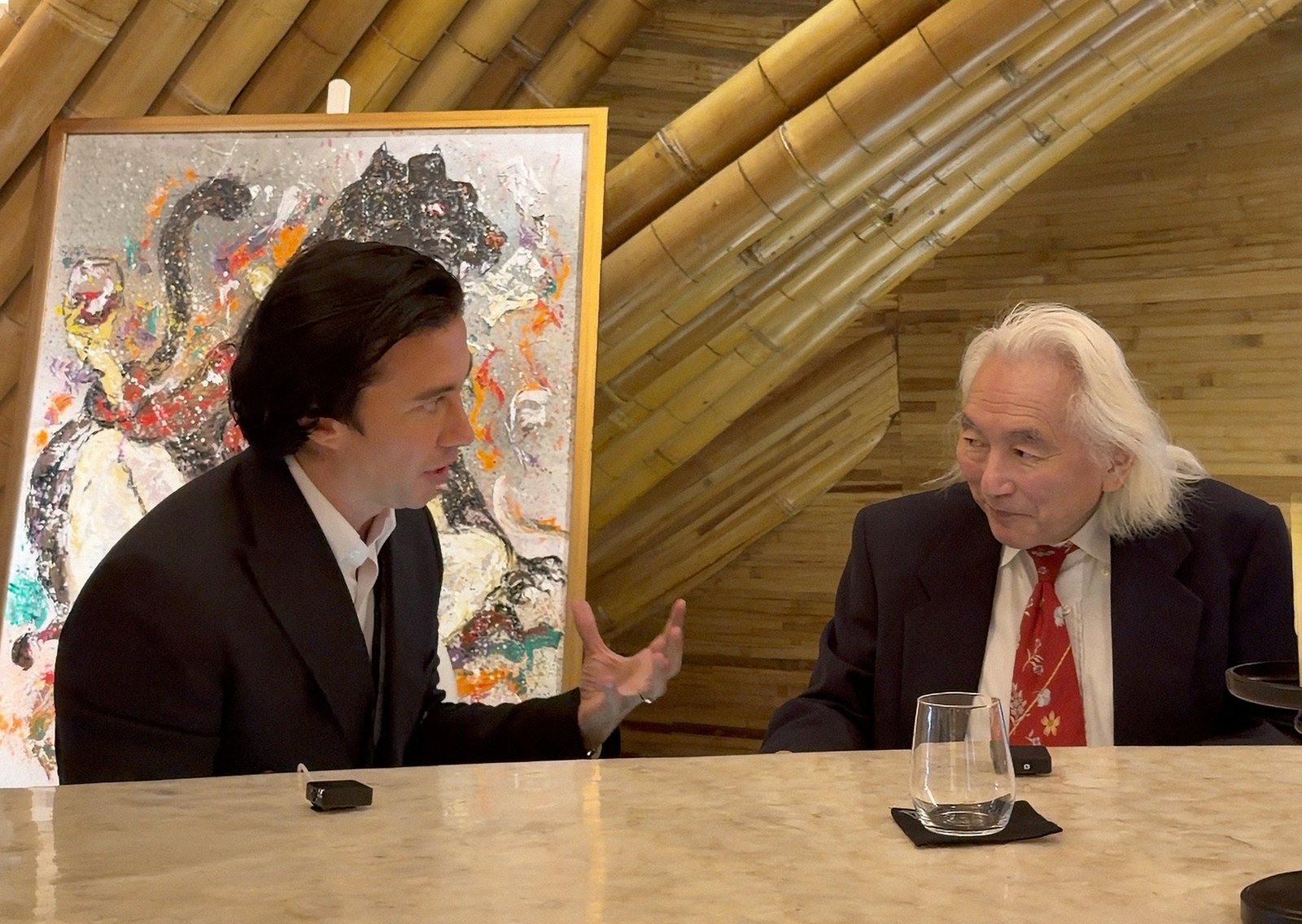
Velco Dar with Dr Michio Kaku in Bali, 6 November 2026.
Michio Kaku said “we’re not there yet” six times during our conversation. He called the destination “inevitable” twice. As a man who has made predictions in public for decades, he holds both positions without strain.
We sat at a marble table in a bamboo-ribbed room at Nuanu Creative City on 6 November, after he had closed the Genius Future Summit. I had come to ask about the brain-net. In The Future of the Mind, published in 2014, two years before Neuralink was founded, Dr Kaku described a successor to the internet that would send emotions, sensations and memories from one brain to another. A video can show you what a place looked and sounded like. The brain-net would send how it felt to be there. I asked whether we will ever be able to send a whole feeling or a whole experience from one person to another.
“Well, to be honest, right now, we are children,” he said. “Children when it comes to reading MRI photographs of the thinking brain.”
He answered as a physicist. “Thinking is electronic,” he said. “It travels at very, very fast velocity. And at the present time, our devices are not sensitive enough, quick enough, and deliberate enough to construct entire thoughts this way.”
He also reminded me how young the field is. “Just remember that a few decades ago, we were totally in the dark,” he said. “It wasn’t until several decades ago that we were able to even see the motion of electrical impulses inside the living brain. So this is a rather new area of investigation. It’s worthy of investigation, but we have to be careful not to imply too much with the data.”
I asked for a wild guess on when the brain-net could be in wide commercial use. “I would say it would take a few decades before we’re able to discern intelligible messages being conveyed in the brain,” he said. He described the present as “knocking on the surface of the door, hoping that somebody’s going to open the door.”
When I pushed further out, to a future in which people steer machines and exoskeletons by brain signal, he marked the border before he crossed it. “If we now go into science fiction, okay, leave the world of hard facts for now,” he said. Then he crossed it. Turning a scan of the whole brain back into language is “not provable at the present time, but I think that, yes, in principle, it’s possible.” Later he put it more simply. “The brain, in some sense, could be an open book,” he said. “I’m just saying hypothetically, it could be possible that one day we’ll be able to read thoughts.”
Two clocks
Dr Kaku kept two things apart throughout. With some patients who have brain damage, he said, “we’ve been able to at least communicate a little bit so that it’s not a total loss.” Researchers can show that “words are conveyed in their brain, so that we know that they’re communicating.” Whole thoughts are a separate problem. “Certain areas of the brain light up when certain things occur,” he said, “but what is it that is being lit up is unknown.”
Clinical results support the near side of that line. In June 2025 a UC Davis team reported real-time voice synthesis for a man with ALS, who could change the intonation of the voice as he tried to speak. On 28 October this year Neuralink said one participant in its speech trial had reached 75 words a minute in the first week of use, a company figure for a single person. Most of these systems read the signals a person produces when trying to speak, the brain’s instructions to the mouth and throat.
The far side is the one Dr Kaku wrote about in 2014: the thought before it becomes an instruction, and the feeling that comes with it. A Stanford-led study in Cell last year decoded some silent inner speech under controlled conditions. Nobody has decoded a full experience yet. That is the territory his “children” line describes.
So there are two clocks. One counts down to a machine that can turn attempted speech or movement into words or action. And for a few trial participants, it already works. The other counts down to a machine that can read what a person means and feels. “A few decades” was his reading of the second clock.
The gold rush
I put a theory to Dr Kaku. The people building frontier AI keep turning up in brain interfaces. Elon Musk controls xAI and Neuralink. Sam Altman runs OpenAI and co-founded Merge Labs. The supply of public text their models train on is finite. I asked whether recorded brain activity is the next source of training data.
“Well, there’s a gold rush,” he said, “in the sense that a lot of people smell a Nobel Prize, smell breakthroughs being made. But that’s basically conjecture.”
He had already given me the rule for ideas like these: “Any conjecture you make has to be prefaced by the fact that it’s still hypothetical.” The theory needs that preface. Neural recordings are already training material. In October, Neuralink described pretraining on 50,000 hours of brain data to improve its decoders. My question remains whether those recordings could eventually serve a wider purpose in AI.
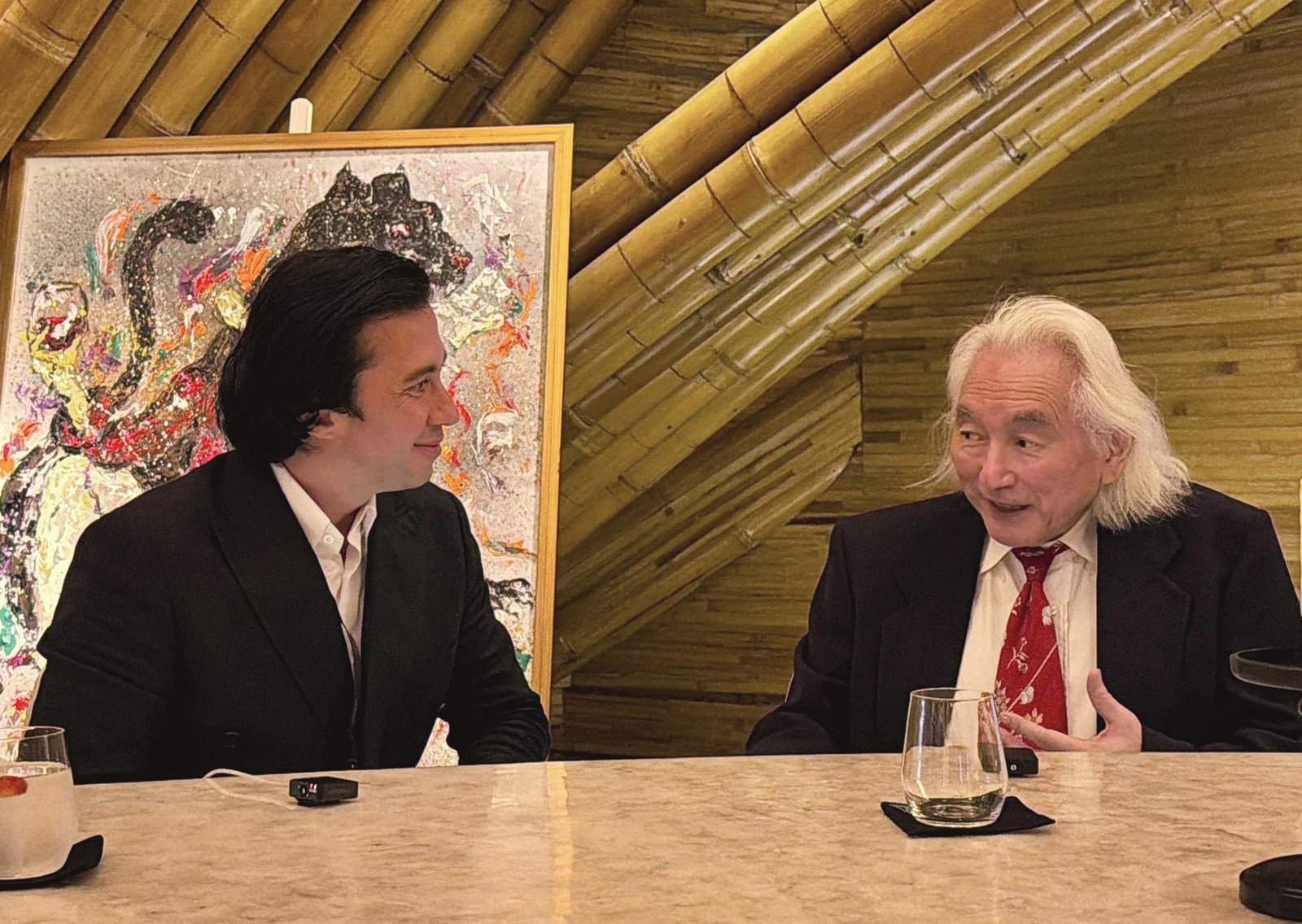
Dr Michio Kaku during our conversation.
After the talkies
My own interest in the BCI industry is commercial. I spent years designing experiences for consumer and luxury brands. People leave a live event feeling different about a brand or message, but often struggle to explain what caused it. We can photograph the event or film it, hoping to transmit some of the experience. The pictures will show who was there and what happened, but the full experience stays geographically anchored.
Dr Kaku has compared the brain-net to the arrival of sound in cinema, which changed what audiences expected from a film. I asked what would disappear in the same way once we can communicate with more fidelity than words and pictures.
“I think it’s inevitable that we will be able to read not just vague emotions, but letters, whole sentences, words,” he said. “I think that’s inevitable, it’s going to come. We’re not there yet, but I think it’s definitely possible.”
Today’s internet is organised around attention because attention is what a platform can measure. I asked what happens to that economy once emotion itself can be measured.
“As we get better and better at deciphering brain signals, then previous work becomes redundant, obsolete, it becomes irrelevant,” he said.
I take “previous work” to include business models built around those measurements. If a company can interpret emotional responses from neural signals, the value of clicks and dwell time will start to drop. In his 2013 essay for The New York Times, Dr Kaku imagined “perfect capitalism,” in which everything about a product and a customer is known. I think the company interpreting the signals, which I call the translation layer, will know more than the users on either side, and charge for access.
An interface that could also convey a feeling from one person to another would take that relationship further. Its software would determine what can be conveyed and how much survives the translation.
Asked when the brain-net might be used widely and commercially, he answered in decades.
The jail of the brain
I asked Dr Kaku whether AI, quantum computing and brain interfaces arriving together, and eventually converging, should scare us or excite us.
“I think we should be cognisant of both possibilities,” he said. “The plus side is enormous. Being able to decipher thoughts in a thinking brain, I mean, that’s incredible, because think of the people that have been trapped inside the jail of their own brain, because they could not communicate with the outside world.”
For a handful of trial participants that has started to change. For nearly everyone else it has not.
“In the future, we will be able to communicate with these people,” he said. “But we’re not there yet.”
It was the sixth time he had said it. I thanked him, and we sat for a photograph.
Quotes from our conversation have been lightly edited for clarity.
Sources
Conversation
- Michio Kaku, conversation with the author, Genius Future Summit, Nuanu Creative City, Bali, 6 November 2026.
By Michio Kaku
- The Future of the Mind: The Scientific Quest to Understand, Enhance, and Empower the Mind (Doubleday, 2014).
- “A Scientist Predicts the Future,” The New York Times, 28 November 2013
- “Mental communication and infinite knowledge are on the horizon,” Big Think (the talkies comparison)
Research and reporting
- UC Davis Health: First-of-its-kind technology helps man with ALS speak in real time, June 2025
- Kunz et al., Inner speech in motor cortex and implications for speech neuroprostheses, Cell, August 2025 (PubMed)
- Epoch AI: Will we run out of data? Limits of LLM scaling based on human-generated data
- Neuralink, 1 October 2026: Pretraining on 50,000 Hours of Unlabeled Brain Data
- InsideBCI, 29 October 2026: Neuralink says an ALS patient reached 75 words a minute with its speech implant
- Dargentic Intelligence Report: Brain-Computer Interfaces, The Takeoff Era (Spring 2026), the Translation Layer thesis