The world’s first approved invasive brain-computer interface sold 13 sets in its first three months on the market. In the same six months, the systems that decide how the technology will be paid for, built on and governed moved much faster than the sales.

The report
Dargentic Intelligence published Issue 02 of its twice-yearly report, Brain-Computer Interfaces: The Infrastructure Race, on 31 October 2026. The 32-page issue covers the six months to 30 September 2026 and sets out decisions for business leaders over the next 6 to 18 months. Its central finding is that invasive implants are being priced, coded and regulated before they are sold, while most businesses will first meet the technology outside the operating room, through developer tools, brain-data models, home headsets and privacy law.
Eight findings
The Executive Brief lists eight findings:
- Businesses can now build on neural input. Meta made its Neural Band toolkit generally available on 30 September, and Neurable licenses EEG sensing to hardware makers. Apple agreed to buy Sonera’s sensor assets and has announced no product.
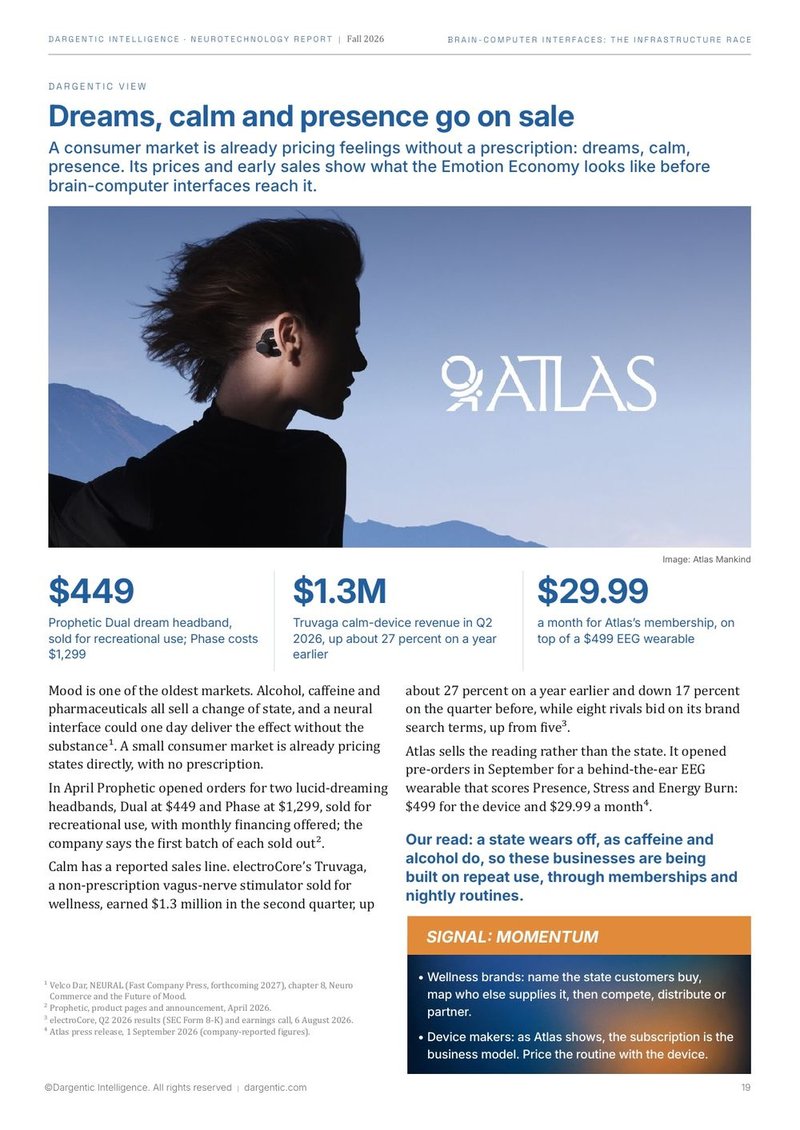
- Feelings are on sale before brain data can prove them. Prophetic takes orders for dream headbands from $449, and Truvaga earned $1.3 million in a quarter selling calm. Advertising tools measure emotion from faces and self-reports, and the brain-response models the report covers are non-commercial or unbuilt.
- Brain models arrive ahead of brain devices. Hemispheric trained a model on more than 250,000 hours of EEG and behavioural recordings, and Conduit advertises $50 a session to collect its own data.
- Capital repriced the category ahead of implant sales. Secondary trades reported in July valued Neuralink at $29 billion to $42 billion, and Precision Neuroscience closed $250 million.
- Payment is now the constraint for approved products. China coded its first invasive brain-computer interface two days after approval, and the United States proposed a Medicare pathway and a procedure code. Most developers still face clinical and regulatory gates.
- The first disclosed sales record is 13 sets. Neuracle told the Shanghai Stock Exchange on 29 September that it had sold 13 sets and implanted 8 since July, at a listed RMB 475,000 a set with no basic-insurance cover.
- The brain became a national-security line item. A congressional commission, a White House strategy, a Bureau of Industry and Security export settlement and two proposed cognitive-warfare mandates arrived by early September.
- Brain-computer interfaces can be attacked, and support is not guaranteed. A September preprint set out five families of attack on AI-powered brain-computer interfaces, from forged signals to backdoored decoders. No supplier the report reviewed commits to support beyond its own exit.
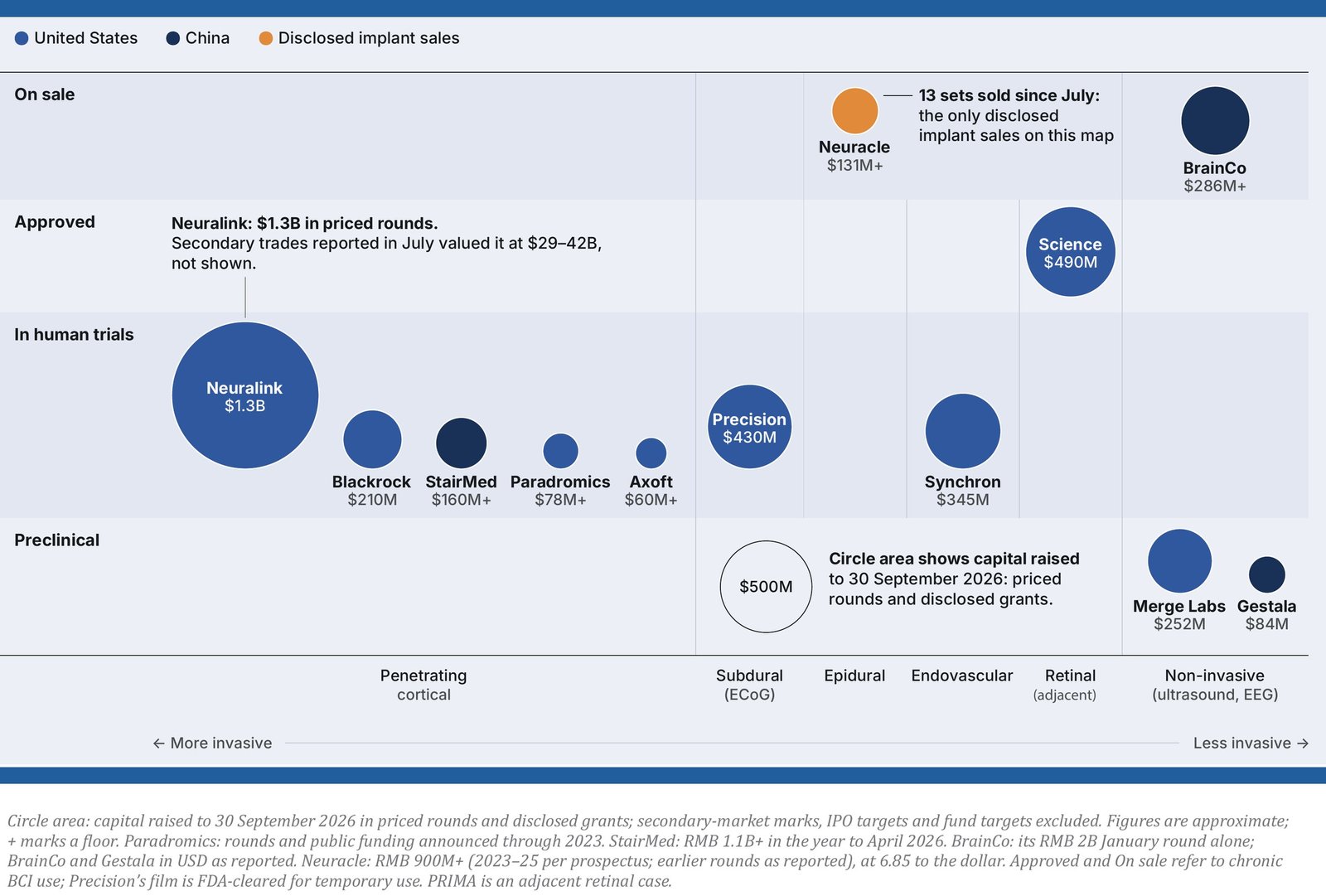
The Competitive Map from Issue 02: implant sales have begun at Neuracle, and most capital is still in trials.
Inside the issue
The issue runs in six sections: Briefing, Capital, Commerce, Dargentic View, Governance and Regulation, and Outlook. Naveen Rao, founder of Neurotech Futures, contributes a guest view, which argues that public investors are pricing neurotech on revenue while private capital still prices it on promise. The Outlook section includes a Forward Radar of developments to watch from October 2026 to April 2027 and a scorecard grading the theses of Issue 01, Brain-Computer Interfaces, The Takeoff Era, published in spring 2026.
Each figure in the report carries an evidence grade: measured, company-reported, planned or undisclosed. Issue 03 is due in spring 2027.
Sample pages


Availability
The report is sold as a single-user PDF for $699, a five-seat team licence for $1,999, and a five-seat enterprise licence with a 60-minute private briefing for $2,999. Government policy teams, regulators, speaker bureaus and tier-one media can request a free copy for institutional review from reports@dargentic.com.
InsideBCI is published by Dargentic Intelligence.
Sources
Primary:
- Dargentic Intelligence: Brain-Computer Interfaces: The Infrastructure Race, Issue 02, Fall 2026, published 31 October 2026
- Neurotech Futures, Naveen Rao
Cross-reference to prior InsideBCI coverage:
- 1 October 2026: Neuracle has sold 13 brain implants at a listed RMB 475,000 each since July
- 25 September 2026: Precision Neuroscience closes oversubscribed $250 million Series D co-led by Pershing Square and the Ackman Oxman Institute
- 13 September 2026: Cambridge-led security team names five attack families that break AI-powered brain-computer interfaces
- 9 September 2026: Apple acquires neural-sensor startup Sonera Magnetics
- 7 August 2026: Naomi Bashkansky quits OpenAI to join BCI startup Conduit